
Sometimes, the most powerful conversations with children happen without words.
For children who have lived through domestic abuse, language can feel unsafe. Words might have been used as weapons, or silence might have been their only protection. When a child’s nervous system is shaped by fear, their body learns that speaking, even about something ordinary, can feel dangerous. Art therapy offers a way through this silence, allowing children to express what their voices cannot yet hold.
At EdShift, our practitioners see this every day. A brushstroke or a lump of clay can become the start of a conversation that reawakens trust and connection. In this blog, we’ll explore how art therapy can unlock the voices of silenced children, how creative and sensory approaches in art therapy can help children affected by domestic abuse move beyond guilt and shame, rediscover safety, and begin to heal.
Trauma and the Silencing of Shame
Trauma doesn’t just happen in the mind, it lives in the body. As psychiatrist Judith Herman outlines in her Trauma and Recovery, recovery from trauma unfolds in three key stages. Safety, Remembrance and Mourning, and Reconnection. Before a child can talk about what has happened, their body and nervous system must first feel safe. Without this foundation, words can retraumatise rather than release. Children who witness or experience domestic abuse often carry deep feelings of shame and guilt. They may believe they caused the violence, failed to stop it, or deserved it. These beliefs keep them locked in isolation, and shame disconnects the child from themselves and from others.
Stephen Porges’ Polyvagal Theory helps us understand why this happens on a physiological level. When a child feels threatened or overwhelmed, their body can enter a “dorsal vagal shutdown”, a state of freeze, withdrawal, and disconnection. In this state, speech, play, and even eye contact become impossible. Healing requires a shift into the ‘ventral vagal’ state, the biological foundation of safety, curiosity, and social engagement. But that shift can’t happen through words alone. For many children, it begins through touch, movement, rhythm, and art.
Why Art? The Language of Safety and Expression
Art therapy gives children a voice when talking feels too hard or too risky. Creative expression works beneath language, engaging the senses and the body to reach parts of the brain that store traumatic memory. Through mark-making, building, and movement, children can begin to tell their stories symbolically, at their own pace, and with a sense of control.
Cathy Malchiodi, one of the leading researchers in the field of trauma and expressive therapies, argues that art allows children to show what words cannot reach. “The expressive arts have a unique role in restoring a sense of vitality and joy in traumatized individuals.”
It invites playfulness, curiosity, and imagination, all essential ingredients for recovery. Art-making also provides predictability. The materials are stable, the process is safe, and the outcome belongs to the child. This sense of structure and ownership begins to rebuild the internal safety that trauma erodes. Over time, this creative rhythm helps regulate the nervous system, enabling children to shift from freeze into engagement and connection.
Shared Art-Making: Co-Regulation Through Creativity
One of the most powerful elements of art therapy is shared art-making, when therapist and child create side by side. The goal isn’t to produce a great piece of art, but to engage in a non-verbal, relational dialogue. Through mirroring, rhythm, and gentle collaboration, the therapist helps the child’s nervous system attune to another person in safety. Research has shown that synchronised creative activity, such as drawing together, sculpting, or painting in rhythm, can reduce cortisol (the stress hormone) and increase oxytocin, which supports bonding and trust. For a child who has experienced chaotic or unsafe relationships, this simple act of co-creating can become a powerful corrective experience. It teaches the body that connection can feel calm, safe, and even joyful.
Beyond shared art-making, there are many ways creative expression can help children process trauma safely and meaningfully. Techniques such as bilateral drawing, sand play, and messy sensory exploration each offer unique pathways for healing, helping children integrate fragmented memories, explore control and secrecy, and reconnect with their bodies through touch, movement, and imagination.
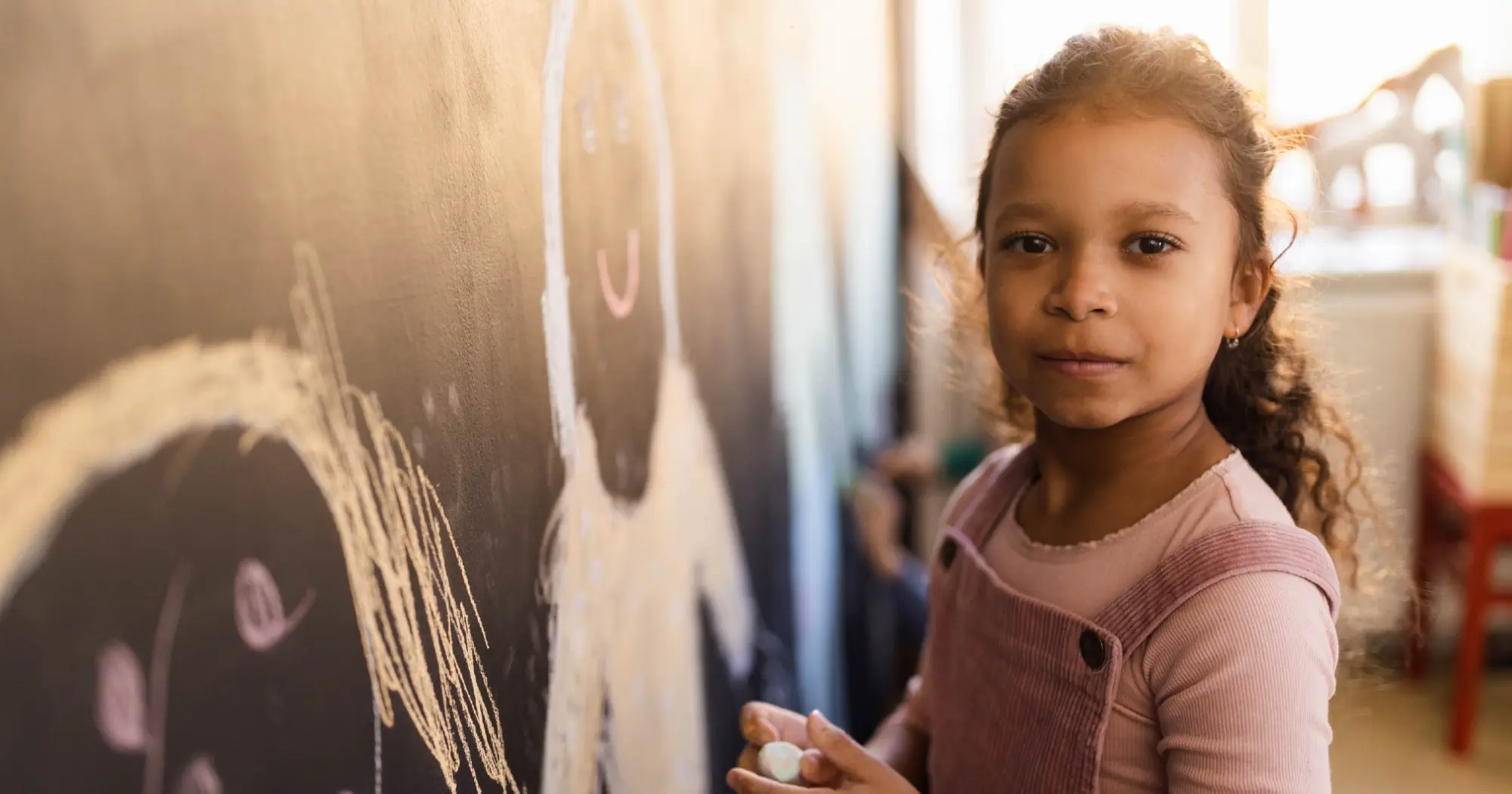
1. Bilateral Drawing: Integrating Fragmented Experience
Trauma fragments memory and sensation, leaving experiences stored in disjointed pieces across the brain. Bilateral drawing, using both hands or crossing the midline of the body while drawing, helps re-integrate these fragments. By engaging both hemispheres of the brain, children can begin to connect thought and feeling, logic and emotion, word and image. A child might use one hand to draw a storm and the other to draw the sun breaking through. The physical crossing of the midline supports neural integration, helping transform overwhelming sensations into coherent, manageable narratives. Over time, this process reduces physiological arousal and builds emotional resilience.
2. Sand Play and the Power of Symbolic Storytelling
In sand play, children build miniature worlds using figures, natural materials, and imagination. Within the boundaries of a tray, they can safely explore themes of control, secrecy, loss, and transformation. A child who feels powerless might bury and then uncover small objects, symbolically practising mastery and discovery. Another might create a landscape of safety, a home, a protector, a bridge to cross. The sand tray becomes both a stage and a sanctuary, where unspoken stories can emerge and be witnessed without judgment or pressure to explain. This symbolic storytelling allows children to process experiences that may be too frightening or confusing to put into words. It restores a sense of agency, the power to create, destroy, and rebuild, all within a safe, contained environment.
3. Messy Play and Sensory Freedom
Trauma often restricts sensory experience. Children living with fear learn to suppress impulses, to stay small, still, and quiet. Messy play reverses this. Working with clay, paint, water, or natural materials helps children reconnect with their bodies through touch, texture, and movement. The act of pressing, rolling, splashing, or moulding engages the sensorimotor system, supporting the body’s transition from freeze to engagement. When a child can safely make a mess, they reclaim autonomy, they learn that their actions can have an effect on the world, and that this power is safe. As psychotherapists Pat Ogden and Janina Fisher describe in their Sensorimotor Psychotherapy, this sensory engagement is foundational. Healing trauma is not just about what we remember, but how our bodies learn to feel safe again.
Restoring Agency: The Power of Choice
Even the smallest decisions, choosing a brush, picking a colour, deciding where to start, can be profoundly healing for a child who has lived under control and coercion. These moments of choice restore a sense of agency, what Judith Herman calls ‘Reconnection,’ the final stage of trauma recovery. In shared art-making, this agency grows through gentle connection. Sitting side by side, drawing or building together, therapist and child find a quiet rhythm of trust. Techniques like bilateral drawing help the brain integrate fragmented memories, while sand play offers a safe space to explore power and secrecy through story and symbol. Messy, sensory play, with clay, paint, or water, helps children move from frozen states to active engagement, rediscovering mastery through touch. Each creative act, however small, reminds them they have a voice, that they can make choices, and that those choices matter.
From Silence to Safety: Art as a Bridge
Healing from trauma is not about blocking out the past, it’s about rebuilding safety, connection, and meaning in the present. For many children who have lived with domestic abuse, feelings of guilt and shame can silence their voices and disconnect them from others. Through shared art-making, bilateral drawing, sand play, and sensory exploration, children find ways to express what words cannot reach. Side by side with a trusted therapist, a child learns that they can create, destroy, rebuild, and choose, and that their choices are safe and meaningful. A child who once sat frozen in silence might trace a line across the page or sculpt a shelter in the sand. Each gesture becomes a quiet act of courage, a reclaiming of power and self.
At EdShift, we believe that creative, embodied therapies offer a bridge between silence and expression. With our range of support programmes, we help children reinhabit their bodies, their choices, and their voices. When talking feels impossible, art gives shape to what has been unspeakable. When children cannot talk, art helps them show what words cannot reach.

You must be logged in to post a comment.